

THIS PAGE WILL BE UPDATED WITH THE LATEST NEWS
UPDATE: 10:30 PM CEST
Bessent Unveils Sanctions Designed to Cripple Iran

Treasury Secretary Scott Bessent announced on Monday that the U.S. will impose punishing sanctions on countries and entities that do business with Iran — an attempt to bring the country to heel absent renewed military strikes.
Why it matters: The plan, which Bessent dubbed “Operation Economic Outcast,” is aimed at ratcheting up pressure on the Iranian regime amid the current “no war, no deal” limbo.
- U.S. officials say the expanded “secondary” sanctions are expected to be the main course of action against Iran until at least after the midterm elections, when a new military campaign could again be on the table.
What he said: “Let there be no ambiguity as to the position of the United States,” Bessent said at a news conference. “An economic engagement of any kind with this murderous regime will expose those responsible to the full reach of American power.”
- Bessent did not give a deadline for compliance, but said, “I’m not going to set a timeline, but we do not have infinite patience here.”
- “No one is above this,” Bessent said in response to a question about whether the initiative would encompass China. “This is economic asphyxiation of this regime … and no one should test our resolve.”
Zoom in: Bessent said the U.S. is expanding the categories of secondary sanctions to the fields of digital assets, technology, gold, aviation and shipping.
UPDATE: 5:00 PM CEST
Iranian Hackers ‘Shut Down UK Power Plant’ For Four Days After Major Cyber Attack

A British power plant was shut down for four days after an unprecedented cyber attack by Iran-linked hackers, according to reports.
The exact location has not been revealed, due to security concerns, but sources have told the Telegraph that the facility was disabled “while staff fought to bring it back online” after the attack. We use your sign-up to provide content in ways you’ve consented to and to improve our understanding of you. This may include adverts from us and 3rd parties based on our understanding. You can unsubscribe at any time. Read our Privacy Policy
It is, however, understood that the plant affected was not one of the biggest sites in the country. Due to the relatively small nature of the plant, the outage had no impact on the UK’s wider power supply or energy generation.
The incident is thought to have taken place in July, at the same time as a series of attacks on US water infrastructure. Those attacks affected 12 states and caused concern in the White House.
In response, the Government briefed the chief executives of power companies and wrote to businesses with advice, direction and next steps.
“The Key to Lasting Peace in the Region Is in Iran”

Franck Radjai, a research director at the CNRS at the University of Montpellier and president of the Association of Academics for Freedom in Iran, fled Iran in 1983 after personally experiencing the repression of the mullahs’ regime; his sister had been executed two years earlier. For more than 40 years, he has followed developments in his country. He hopes that the Iranian people can bring about regime change themselves. Amid geopolitical challenges, the economic consequences of the Strait of Hormuz crisis, negotiations between the United States and Iran, and the human rights situation, Franck Radjai discusses the Iranian people’s resistance and their hopes, seeking to shed light on the reality of Iran.
Negotiations between Iran and the United States are underway. How should the escalation of demands between the two sides be interpreted?
Since the beginning of the war, the reasons officially given by Donald Trump, who said it was to help the Iranians, are obviously not really the main reasons. This is a geopolitically important region. And that is perhaps clearer to everyone now. Whatever the reasons for its outbreak, this is another war. It is worth remembering that shortly beforehand there was the 12-day war (editor’s note: June 13–24, 2025), followed by attacks on Western interests through proxies across the region, not to mention hostage-taking. This is the regime’s usual chaotic behavior as it seeks to subjugate others and create a form of deterrence extending far beyond its borders.
UPDATE: 7:00 AM CEST
Over 600 Political Prisoners in Ahvaz’s Sheiban Prison Amid Overcrowding, Summary Trials, And Death Sentences

A comprehensive report released by the Iran Human Rights Society on August 22, 2026, reveals that more than 600 political and ideological prisoners are currently detained under dire conditions in Sheiban Central Prison in Ahvaz. Following extensive waves of arrests by regime security and intelligence forces across Khuzestan Province, the facility’s total inmate population has surged to over 4,000—more than double its official 2,000-person capacity. The vast majority of those recently detained are young men aged 18 to 25, who are being subjected to summary, video-conferenced mass trials inside the prison, denied independent legal counsel, and handed sentences ranging from lengthy prison terms to capital punishment.
Intelligence units of the Islamic Revolutionary Guard Corps (IRGC) and state security apparatuses have carried out extensive nighttime raids targeting residential neighborhoods across Khuzestan Province, particularly in Ahvaz, Shadegan, Izeh, Behbahan, and Masjed Soleyman. Hundreds of young citizens have been arbitrarily detained without judicial warrants and initially held in undisclosed interrogation centers before being transferred to Sheiban Prison. Families have systematically been denied information regarding the official charges, detainee whereabouts, or legal status.
The report documents that judicial proceedings are being conducted inside the prison via video conference in group formats, severely undermining the right to a fair defense. Detainees are barred from reviewing their case files or consulting with independent defense attorneys.
Iran: Female Prisoner, 35, Executed in the Central Prison of Karaj

In the early hours of Sunday, August 23, 2026, the Iranian regime executed a female prisoner, identified as “Maryam” in the Central Prison of Karaj.
Maryam, 35 and a native of Karaj, had previously been arrested on charges of murder and sentenced to death by the clerical regime’s judiciary. Over the past week, she was subjected to severe psychological torment.
She was initially transferred to solitary confinement to face execution, but after a temporary stay, she was returned to the general ward. However, prison authorities transferred her back to solitary confinement on Saturday, August 22, and carried out her death sentence early Sunday morning.
Maryam’s execution in the Central Prison of Karaj brings the total number of women executed in Iran since the beginning of 2026 to at least 22.
Iran’s Regime Infighting: A Sign of a Deepening Crisis of Survival
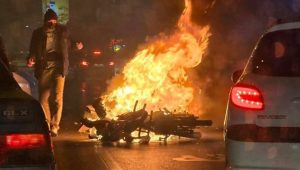
The intensifying disputes within Iran’s ruling establishment raise a fundamental question: Are these merely factional disagreements, or do they point to something far more consequential?
The answer lies beyond the immediate quarrels between competing power centers. In political systems, the escalation of internal conflicts is often a reflection of deeper structural crises. When a government faces widespread public discontent, economic hardship, social unrest, political instability, and the erosion of its social base, disagreements within the ruling elite inevitably become sharper.
This is precisely what is increasingly visible in Iran.
The regime’s internal confrontations are not simply disputes over policy or administrative methods. They increasingly resemble a struggle over responsibility, power, and ultimately political survival.
A government with broad social support can generally absorb internal disagreements. Competing factions can negotiate, compromise, and resolve disputes through established political mechanisms.
Iran Links Strait of Hormuz Shipping to Sanctions Relief as Regional Bypass Routes Expand

TEHRAN — The Strait of Hormuz is no longer merely a site of naval confrontation or a threat to halt tanker traffic after the Iran-U.S. war. Tehran is now linking the normalization of shipping through the waterway to a broader set of demands, ranging from lifting the blockade and easing sanctions to the implementation of previous U.S. commitments, effectively seeking to turn its geographic power in Hormuz into bargaining leverage.
Donya-e Eqtesad, in interviews with four international affairs experts, described Tehran’s current policy as resting on three tools: negotiations, military deterrence and economic resistance. Hormuz is the point where all three converge; Iran can place the normalization of traffic on the negotiating table, retain the threat of disruption as backing for diplomacy, and buy time for bargaining by enduring economic pressure.
Rahman Ghahremanpour, an international affairs analyst, said of the choice facing Tehran: “There are currently two views regarding Iran’s approach to U.S. economic pressure and blockade against our country: the first is escalation, and the second is a return to the agreement, with the consensus within the ruling establishment leaning more toward a return to the agreement.”
The issue, therefore, is no longer simply whether Iran can close Hormuz; the question is what it will receive in return for normalizing it again.
Bucharest Exhibition Commemorates Iran’s 1988 Massacre and Condemns Executions
Bucharest, Romania – August 22, 2026 – Supporters of the Iranian Resistance, including the NCRI and PMOI, held a photo exhibition in Bucharest to commemorate the anniversary of the 1988 massacre of political prisoners in Iran and to condemn the Iranian regime’s continued use of the death penalty.

The exhibition honored the memory of thousands of political prisoners who were executed during the 1988 massacre and paid tribute to all those who have lost their lives in Iran’s struggle for freedom and human rights. Participants called for justice for the victims and stressed the importance of preserving the memory of those who lost their lives in pursuit of freedom and democracy.
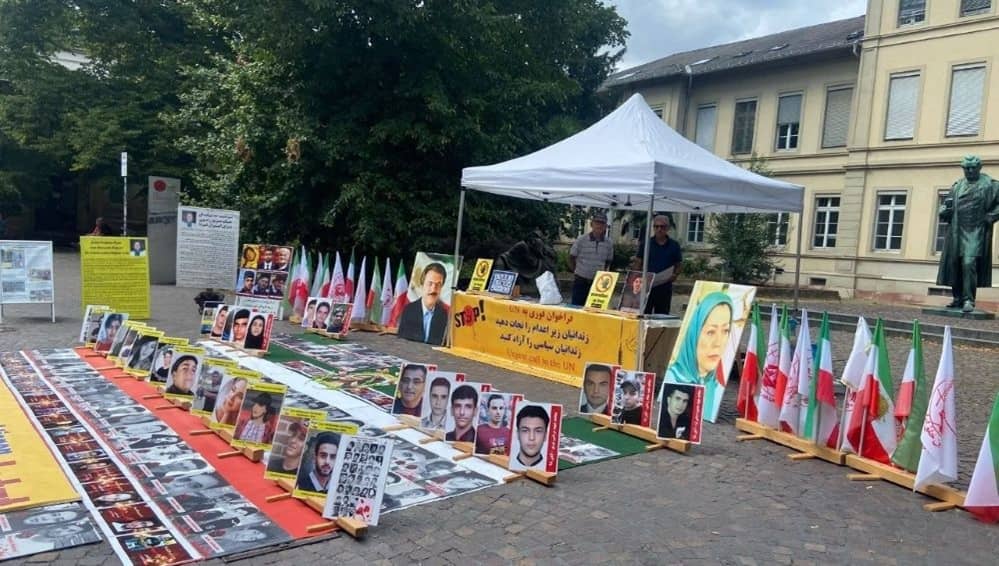
Heidelberg Rally Commemorates Iran’s 1988 Massacre and Condemns Executions
Heidelberg, Germany – August 22, 2026 – Supporters of the People’s Mojahedin Organization of Iran (PMOI/MEK) held a rally and photo exhibition in Heidelberg to commemorate the anniversary of the 1988 massacre of political prisoners in Iran and to condemn the ongoing use of the death penalty by the Iranian regime.

The event honored the memory of thousands of political prisoners who were executed during the 1988 massacre and paid tribute to all those who have lost their lives in Iran’s struggle for freedom and human rights. Participants called for justice for the victims and emphasized the importance of preserving the memory of those who lost their lives in pursuit of freedom and democracy.